Type of Work: Scholarly Book.
Details: Liverpool University Press, 360pp.
Year: 2022.
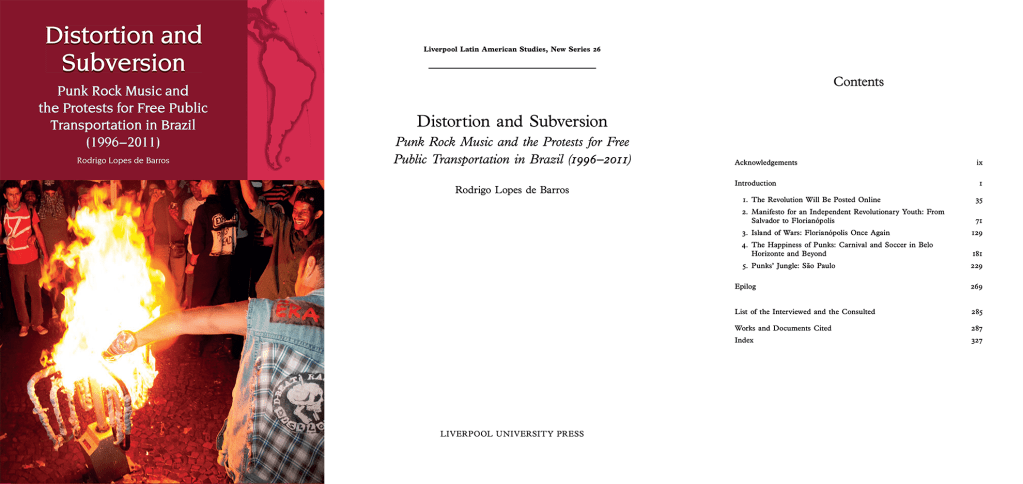
At the turn of the 21st century, the Brazilian punk and hardcore music scene joined forces with political militants to foster a new social movement that demanded the universal right to free public transportation. These groups collaborated in numerous venues and media: music shows, protests, festivals, conferences, radio stations, posters, albums, slogans, and digital and printed publications. Throughout this time, the single demand for free public transportation reconceptualized notions of urban space in Brazil and led masses of people across the country to protest. This book shows how the anti-capitalist, anti-bourgeoisie stance present in the discourse of a number of Brazilian bands that performed from the late 1990s to the beginning of the 21st century in the underground music scenes of Florianópolis and São Paulo encountered a reverberation in the rhetoric emanating from the Campaign for the Free Fare, subsequently known as the Free Fare Movement (Movimento Passe Livre, or MPL). This allowed the engaged bands and the movement for free public transportation to contribute to each other’s development. The book also includes reflections on the Bus Revolt that occurred in the northeastern city of Salvador, unveiling traces of the punk and anarcho-punk movements, and the Revolution Carnivals that occurred in the city of Belo Horizonte, an event that mixed lectures, vegetarianism, protests, soccer, and punk rock music.
Related Content
-
In the book’s epilogue, Lopes de Barros writes that “[p]unk music functioned as a path for revolt: the initiator, the conductor, the basis, a point of orientation” (270; author’s emphasis). He more than proves this point for the Brazilian punks who were active in the bus protests.
-
“Distortion and Subversion” contributes to the areas of urban studies, geography, cultural studies, sociology, Latin American activism, mass mobilizations, among others. The book is an important contribution to the literature on student-led and youth-led movements as well as on punk counterculture and subculture.
-
Rodrigo Lopes de Barros provides a rich overview of youth demonstrations and protests against fare increases in cities such as Salvador, Florianópolis, São Paulo, and Belo Horizonte, examining the popular motivations behind the protests and how punk rock and hardcore bands influenced these motivations and engaged in politics.
-
CITIES ARE, BY THEIR ESSENCE, PLACES of movement. Even if in some cases this is not visually perceptible, they pulsate with the desire for change, typically expressed by the impetus of youth. In the case of Brazil, young people have been shaking up the official state structures and the musical scenes in cities of different regions…
-
It’s 2003, and my friends and I are cruising along the few paved streets of Jequié, in the interior of the state of Bahia, by skateboard. Our uncombed curly and afro hair hangs loose, and “gringo” rock band t-shirts flutter in the wind generated by the movement of our small wheels. Jequié has a population…
-
On Monday, November 14, 2022, the Boston University Initiative on Cities (IOC), BU Department of Romance Studies, Department of Political Science, City Planning & Urban Affairs Program, Center for Latin American Studies, Center for the Humanities, and Center for Innovation in Social Science hosted a discussion by Rodrigo Lopes de Barros.
 Rodrigo Lopes de Barros